Category Archives: Uncategorized

Leon Weinstein – In honor of his 100th Birthday.

Leon Weinstein was born in 1910 into a large, extended family of Hassidic Jews who had lived in Poland for many generations. He married his childhood sweetheart, Sima, in 1939, and they gave birth to a daughter, Natalie, in 1940, as their town of Radzmin was becoming a ghetto.

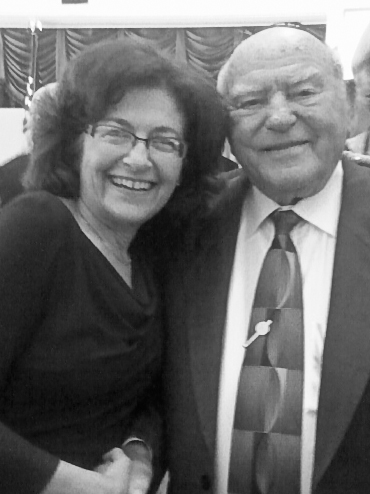
I was fortunate to celebrate with the 1939 Club, Leon’s 100th birthday on Sunday, May 16. Leon has an inspiring story of survival, yet suffered as many did with the loss of many family members.  The dangerous situation forced Natalie’s parents to leave their 18 month old child at a door step, hoping someone would care for her.  Sima found shelter, but eventually perished while Leon worked with the resistance, smuggling arms into the Warsaw Ghetto.  Miraculously, Leon survived the Warsaw Uprising.

After the war, Leon eventually found his daughter in a convent, and married Sophie Sikora, a survivor of Auschwitz.  The family moved to France, and eventually, the United States in 1952.

Leon was instrumental in the rescue of countless Jews and the repossession of 13 sefer Torahs, stolen from the synagogue during the War Years.

The loss of his entire family set Leon on a lifelong quest of restoring the religious and warm communal life into which he was born. Continuous membership in a synagogue, support for Israel, and The “1939” Club has helped to fulfill that quest.  Leon and Sophie have been members of the 1939 Club for over 50 years. Sophie filled many capcities and offices of the 1939 Club until she passed away in 2005.

It was an honor to meet Leon, learn of his story, and participate in a milestone celebration of his first 100 years.

– Julie.
VOG mentioned in ‘Faith Matters’ weblog

Bill Tammeus, the former Faith columnist for The Kansas City Star, has a weblog titled ‘Faith Matters’, at http://billtammeus.typepad.com/ Bill has graciously mentioned VOG in his posting today, ‘Faith this and that: 4-28-10’. Bill notes the article that appeared in Der Spiegel, and also mentions his work to help preserve the stories and memories of the Holocaust.

Thank you Bill for your kind words, and for helping to keep the memories alive.

Der Spiegel story on VOG sparks further coverage

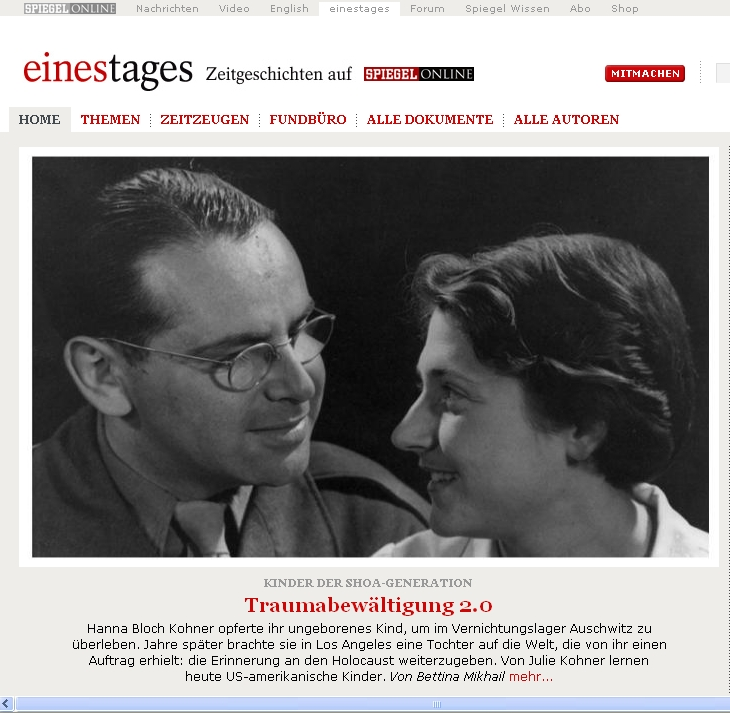
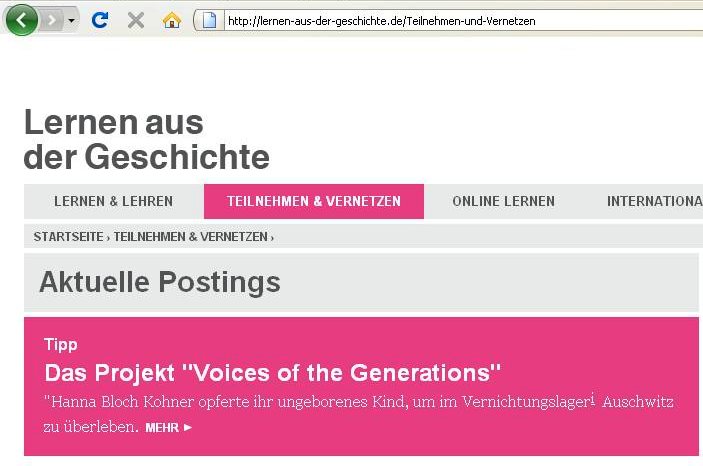
The article in Der Spiegel has sparked further coverage of VOG. Bettina Mikhail has kindly posted a short article to the site, Lernen aus der Geschichte (Learning from History).

Here is the english translation:

Hanna Bloch Kohner sacrificed her unborn child to survive in the Auschwitz death camp. Years later, she moved to Los Angeles California where she married Walter Kohner and tried to let her memory of the Holocaust pass.

Since 1991, Julie Kohner has presented in the U.S. her project “Voices of the Generations” (“Voices of the Generations”), a nonprofit, charitable organization dedicated to “Holocaust Education”.

The former teacher and daughter of Hanna Block Kohner, she knows that children are better able to identify with personal stories in order to understand what millions of people suffered in the Nazi extermination camps. Julie Kohner also presents her mother’s story to adult audiences. The story she tells is how her mother survived the war in five different Nazi camps.

Julie Kohner wants to present her program not only in the U.S. but also in Europe, and especially in Germany. In order to guide teachers Julie has developed a curriculum for her mother’s story. She also  wishes to go one step further with a plan to build a Web 2.0 platform where children and grandchildren of the victims of the Shoah can contribute videos of their own personal stories and experiences.Titled  “Echoes of the Past”, the forum will serve as an archive for school education and for future generations.

The German version is available at the following link: http://lernen-aus-der-geschichte.de/Teilnehmen-und-Vernetzen/Tipp/8170

Counting Keys

Sunday February 22; lecture by Michael Berenbaum at Los Angeles Museum of the Holocaust. Sponsored by Second Generation.

Dr. Berenbaum is one of the foremost Holocaust scholars in the USA and the world. He is the director of the Sigi Ziering Center for the Study of the Holocaust and Ethics at American Jewish University where he is also a Professor of Jewish Studies. Not only is Dr. Berenbaum generous with his time speaking weekly it seems on topics of interest to those who share his passion to preserve the memory of the Holocaust as well as understand it, he is always engaging in that he has something to offer that is not widely known about the Holocaust. Such was the case on this Sunday afternoon.

He announced that a new field known as genocide archaeology has emerged. One of the initial scholars working in the field is Father Patrick DuBois who has located more than 2,000 previously unknown

graves of murdered innocents in Lithuania, Latvia and the Ukraine. These discoveries are completely new and are the foundation for the reconsideration of the death tool in this region, as well as for the Holocaust itself. The methods used by DuBois, who is a Roman Catholic priest, are powerful if subtle. He visits villages and inquires of the elder citizenry “where are the Jews buried?” These are the people, he suspects, who had contemporary knowledge of where were killing fields. He counts on his frocks to persuade a “confessional” response. When he travels to the sites he begins digging in the topsoil. More often than not DuBois finds keys and bullets that tell him a story.

The significance of the keys, said Berenbaum, is that victims were innocent and did not realize they were being taken to their death. It also suggests they knew their murderers. The significance of the bullets is that certain casings were used by certain groups: i.e., the SS used one kind, the Wehrmacht another, and the local police a third kind. DuBois’ chilling conclusion is that, based upon his discoveries, the victims’ murderers were often local police encouraged in one way or another by neighbors.

Berenbaum described German occupied Russia as the “black hole” of Holocaust death data. These new discoveries will help fill in the gap as well as document the long suspected pattern of opportunistic murder wherein the locals pulled the triggers but attributed the actions to the Nazis. Claims based upon memories of survivors from these regions have been discounted because of the lack of evidence. Until now.

“Arbeit Macht Frei” – Why it is so important!

“Arbeit Macht Frei” has powerful meaning.  Once it stood for intolerance, now a memorial to the millions lost.  The cry for remembrance has never been louder.  There are about 200,000 Holocaust survivors remaining in the world today.  It is their story and the story of their children & grandchildren that must also live on. Some are unique, many are engaging. The story must be told, their archives curated, and their memories never forgotten.